· By Olivier Bernal
Homework planner template: free printable PDF
A free homework planner template to print (PDF): one school week with subjects, assignments, due dates and tests, plus a page to split big projects into steps.
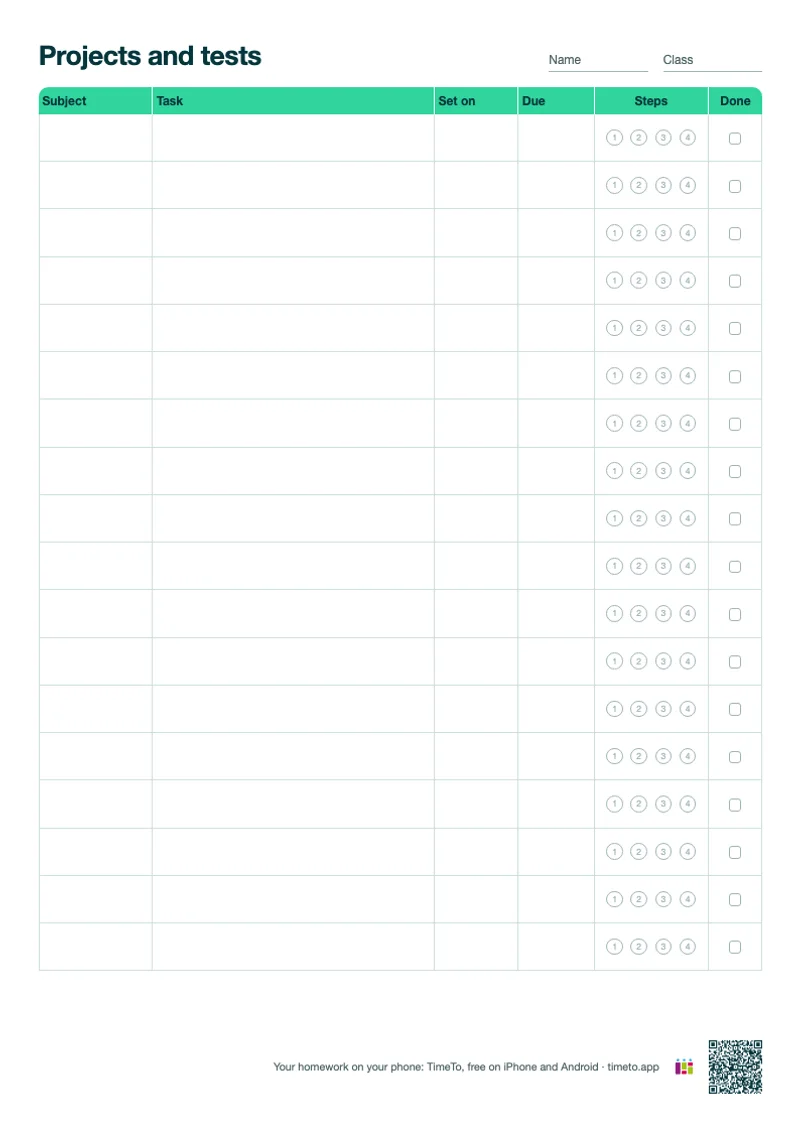
Download the free homework planner template: weekly homework planner (PDF, 2 pages). Page 1 is one school week: for each day, the subjects, the assignments, the due date and a box to check, plus the tests coming up. Page 2 tracks big projects over several weeks, split into steps. Fill it in during class, check it every evening, and nothing gets lost.
Most missed assignments are not hard ones. They are the ones written on the back of a worksheet, or not written down at all. A printable homework planner fixes that with one habit: every assignment goes in the same place, with its due date, the moment it is given. This homework planner template keeps a whole week of assignments and tests on one sheet, and the second page turns long projects into small steps you can check off.
What is in this homework planner template
- Page 1, your week. Monday to Friday get four lines each, the weekend gets three. Each line has a subject, the assignment, the due date and a checklist box. At the bottom, a “Tests this week” table with the date and what to review.
- Page 2, projects and tests. Long assignments over several weeks: subject, task, the day it was set, the due date, four step circles and a “Done” box.
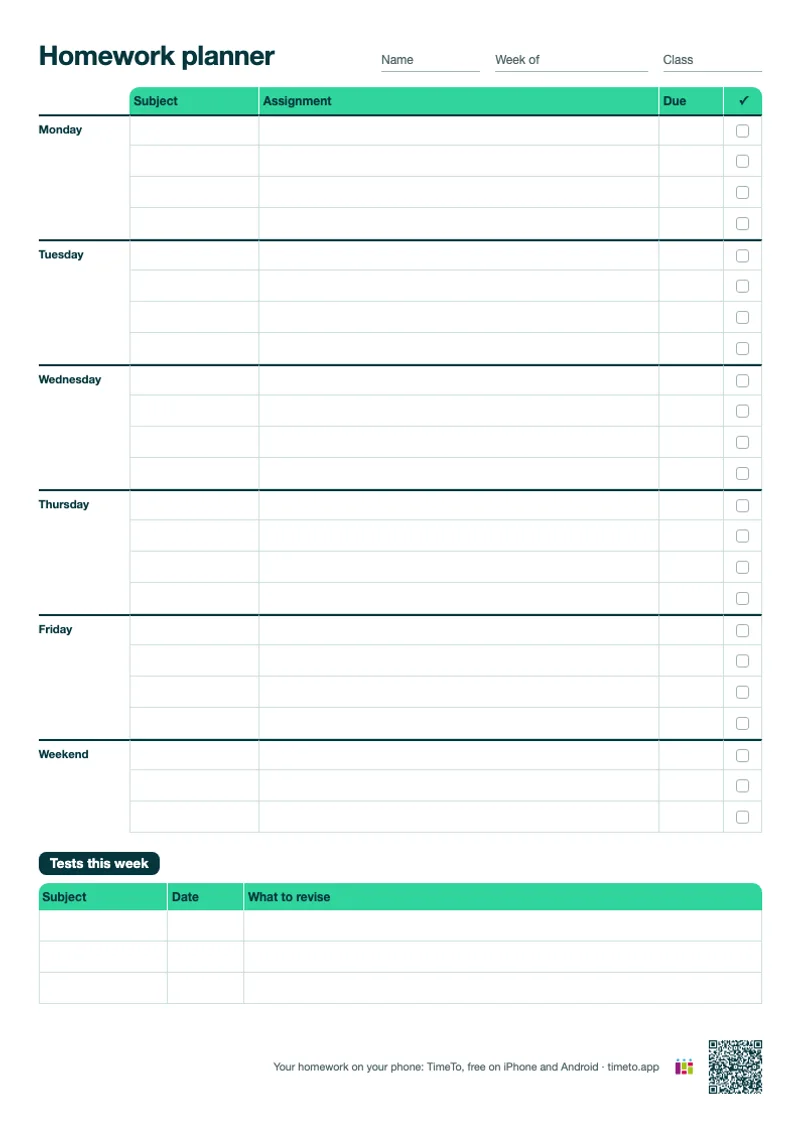
It prints on US Letter or A4 (choose “fit to page” on Letter), in portrait. The green headers stay readable in black and white, so a school printer is fine. Print one page 1 per week and keep a single page 2 for the whole grading period.
How to fill in a printable homework planner
- Write it down in class, not at home. When the teacher gives the assignment, write it on the line for today: subject, what to do, due date. Memory is the weak link, not motivation.
- Write the due date, not the day it was given. “Wed” in the due column tells you when it matters. Sort your evening by due date: what is due tomorrow comes first.
- Be specific. “Math” is not an assignment. “Worksheet 4, exercises 1 to 6” is, and you know when it is done.
- Check the box when it is really finished. Packed in your bag, uploaded, printed. A half-done assignment keeps its empty box.
- Look at the whole week every evening. Five minutes is enough to see what is due tomorrow, which test is coming, and which project step you can start tonight.
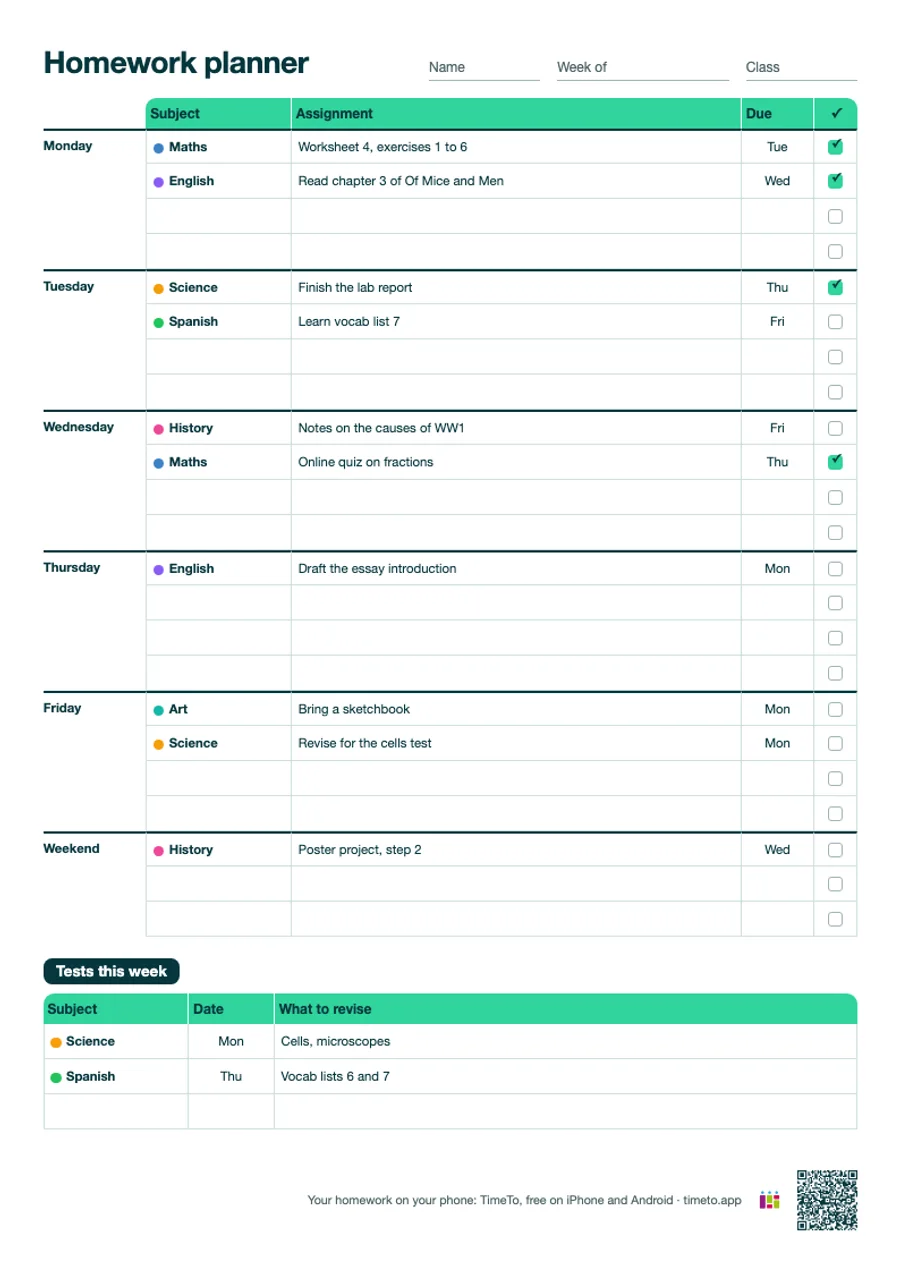
Here is a week once the homework tracker is filled in: two or three assignments a day, the checked boxes for the ones done, and two tests on Monday and Thursday in the bottom table.
Use page 2 for projects and tests
A science fair project or an essay due in three weeks never fits on one line. Put it on page 2 the day it is set, and split it into four steps: research, plan, draft, final version. Give each step its own day on page 1 of the following weeks, and fill a circle each time a step is done. When the due date comes, there is nothing left but the last step.
Tests work the same way. Write the date as soon as the teacher announces it, then put two or three short review sessions on the days before, rather than one long one the night before. Our revision timetable template goes further for exam season, with a four-week plan.
How much homework is normal?
Less than it feels like on a busy week. In PISA 2012, 15-year-olds across OECD countries reported spending almost five hours a week on homework, and the OECD found that beyond about four hours a week, extra time made little difference to results (PISA in Focus 46, Does homework perpetuate inequities in education?). In other words, the goal is not more hours: it is doing the right assignments, on time, without the last-minute panic. A weekly homework planner template shows you at a glance whether a week is light or overloaded, early enough to spread the work.
If a grade worries you, our weighted grade calculator shows the score you need on the next test, which helps you decide which subjects deserve the extra time.
Your teacher gives a project due in three weeks. What do you write in your homework planner today?
Writing it down the day it is set, with its steps, is what keeps a long project from turning into one late night. On the due date alone, you only see it when it is too late.
Paper or app for your homework?
Paper is great for seeing the whole week at once, and writing things down helps you remember them. Its limits: it stays at home when you forget it, and it does not tell you anything on its own.
TimeTo keeps the same list on your phone. In the Homework tab, you add an assignment from the class itself, with its due date and a comment, and mark it as to do, in progress or done. Late assignments are flagged, tests have their own filter, and a calendar view shows the month. For a test, TimeTo can suggest revision sessions before the date, and homework due in five days or more can get prep sessions too. Homework, tests and these sessions are free. Reminders and homework photos are part of the optional Premium subscription.
Many students use both: the printable homework planner on the desk, the app in their pocket. Put your class schedule template next to it, so you know which subjects you have tomorrow.
In short
Print the homework planner template, write every assignment the moment it is given with its due date, split big projects on page 2, and look at your week every evening. To keep the same list on your phone, download TimeTo for free on iPhone and Android.